
Architecting Connected Commerce: Solving Operational Bottlenecks with Advanced Integrations
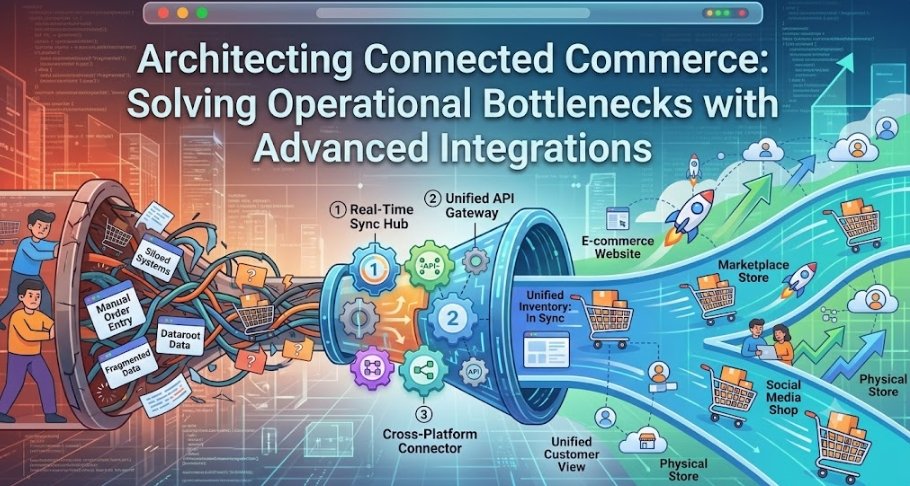
In the rapidly evolving digital marketplace, launching an online storefront is merely the first step in a much larger operational journey. As eCommerce businesses scale, they inevitably adopt a variety of software tools to manage different facets of their daily operations. A typical mid-market retailer might use one platform for hosting their digital storefront, another for tracking customer relationships, a third for managing multi-warehouse inventory, and a fourth for handling complex financial accounting.
While each of these specialized tools may be best-in-class individually, running them in isolation creates a fragmented technological ecosystem. For growing merchants, this lack of connectivity rapidly devolves into a severe business problem, stifling growth, frustrating customers, and eroding profit margins through hidden operational inefficiencies.
Addressing these technical roadblocks requires moving away from manual processes and embracing robust, automated platform integrations.
The Core Business Problem: The Cost of Disconnected Data Silos
The primary obstacle facing scaling eCommerce operations is the existence of disconnected data silos. When an online storefront is not natively communicating with back-office systems, every piece of data must be moved manually or via rudimentary, error-prone batch exports.
Consider the standard lifecycle of an online order. A customer places an order on the website. If the storefront is disconnected from the inventory management system, the stock levels are not updated in real-time. This latency frequently leads to overselling—a scenario where multiple customers purchase a product that is already out of stock. The resulting order cancellations severely damage brand reputation and customer loyalty.
Furthermore, disjointed systems create a heavy reliance on manual data entry. Staff members are forced to spend hours manually copying order details into accounting software, updating shipping statuses, and migrating customer contact information into marketing databases. This manual administrative burden is not only incredibly expensive in terms of labor costs, but it also introduces a high probability of human error.
A single mistyped address or incorrect decimal point in a financial ledger can lead to misrouted packages, inaccurate tax reporting, and massive logistical headaches.
To achieve sustainable, profitable growth, eCommerce businesses must eliminate these friction points by ensuring their frontend sales channels are tightly woven into their backend operational software.
Transforming Operations Through Strategic Platform Synergy
One of the most effective ways to solve the problem of data fragmentation is by connecting a versatile frontend platform with a comprehensive suite of business applications. For many merchants, establishing a seamless zoho shopify integration represents a pivotal turning point in their operational maturity.
Shopify provides an exceptionally fast, consumer-facing shopping experience, while the Zoho software suite offers robust enterprise-grade applications for everything from customer relationship management to financial auditing. By bridging these two ecosystems, businesses can entirely automate the flow of mission-critical data, transforming a web of separate applications into a single, cohesive commerce engine.
Key Benefits of a Unified Technology Stack
Integrating powerful back-office tools with a high-traffic digital storefront unlocks several transformative business benefits:
- Intelligent Inventory Management: A direct connection to an application like Zoho Inventory allows for real-time stock synchronization across multiple sales channels and physical warehouses. As soon as an item is purchased online, the global inventory count is immediately updated, triggering automated low-stock alerts or generating purchase orders for suppliers. This eliminates stockouts and reduces the carrying costs associated with over-ordering.
- Automated Financial Reconciliation: Manually reconciling eCommerce sales, processing fees, and taxes is notoriously complex. By linking the storefront directly to accounting software like Zoho Books, every transaction, refund, and shipping fee is automatically categorized into the correct financial ledger. This ensures that tax reporting is perfectly accurate and allows financial controllers to generate real-time profit and loss statements without waiting for end-of-month manual audits.
- Enhanced Customer Relationship Management (CRM): Customer data is the most valuable asset a digital brand possesses. Integrating the storefront with a dedicated CRM ensures that every customer interaction, past purchase history, and abandoned cart record is centralized. Sales and support teams gain a 360-degree view of the buyer, enabling highly personalized marketing campaigns, tailored customer support, and sophisticated segmentation strategies that drive repeat purchases.
- Streamlined Order Fulfillment: Automated data flows mean that the moment an order is verified, it is instantly routed to the fulfillment center with the correct shipping labels and packing slips generated automatically. This drastically reduces order processing times, ensuring that customers receive their products faster and with highly accurate, real-time tracking information.
Best Practices for Executing Complex System Integrations
Achieving seamless connectivity between entirely different software architectures is a complex technical endeavor. To prevent data corruption and ensure a stable integration, development teams must adhere to a strict set of architectural best practices.
1. Meticulous Data Mapping and Cleansing
Before connecting any two systems via API, a comprehensive data mapping exercise is mandatory. Developers must define exactly how data fields in the storefront correspond to the fields in the CRM or ERP. For example, ensuring that a SKU field matches precisely, and that date formats, currency symbols, and customer name fields align perfectly. Prior to the integration going live, all existing data must be cleansed to remove duplicates, correct formatting errors, and ensure a pristine baseline.
2. Utilizing Middleware for API Rate Management
High-volume eCommerce stores process thousands of requests per hour. Directly linking two platforms can sometimes exceed API rate limits, causing data transfers to fail or timeout. Best practices dictate the use of robust middleware or intelligent queuing systems. This architecture securely holds data in a staging area and feeds it into the receiving system at an optimized rate, ensuring zero data loss even during massive traffic spikes like Black Friday sales.
3. Establishing Bi-Directional Synchronization
A true integration is rarely a one-way street. Establishing bi-directional synchronization ensures that if a customer service representative updates a shipping address inside the CRM, that change is instantly reflected back on the customer’s account dashboard on the storefront. This two-way communication guarantees that both systems act as a unified single source of truth.
4. Comprehensive Staging and QA Testing
Integrations should never be pushed directly to a live production environment. Rigorous testing must occur in an isolated staging environment. Quality Assurance (QA) engineers must simulate high-stress scenarios, processing test orders, initiating complex refunds, and triggering edge-case inventory scenarios to ensure the data flow remains unbroken and accurate under all conditions.
The Crucial Role of Expert eCommerce Development Services
While there are many basic plug-and-play connector apps available on the market, these out-of-the-box solutions frequently fall short for businesses with customized workflows, complex product variants, or high daily transaction volumes. Generic connectors often lack the flexibility required to map custom data fields and can introduce their own performance bottlenecks into the server environment.
Overcoming these advanced technical challenges requires the specialized skills of a dedicated development team. Whether a merchant is looking to optimize a cloud-hosted environment or requires the heavy-lifting architectural expertise of a seasoned magento website agency, partnering with experienced professionals is a critical investment.
Amasty stands as an authoritative and deeply experienced eCommerce service provider, equipped with granular technical knowledge across both the Adobe Commerce (Magento) and Shopify ecosystems. Their approach to systems integration goes far beyond merely installing a connector. They deploy dedicated teams of backend engineers, API specialists, and project managers who thoroughly audit a merchant’s operational workflows before writing a single line of code.
By leveraging deep industry expertise, Amasty builds robust, custom-tailored integration architectures that are designed to handle immense scale. Their solutions prioritize security, data integrity, and server performance, ensuring that as a business grows, its technological foundation remains stable, lightning-fast, and deeply interconnected.
Conclusion
The modern eCommerce landscape is defined by speed, accuracy, and customer experience. Operating a business in isolated data silos is a hidden tax on profitability and a major barrier to scalability. By embracing advanced platform integrations, businesses can entirely automate their most tedious workflows, eliminate costly human errors, and provide a frictionless experience from the moment a customer clicks buy to the moment the package arrives.
Relying on established best practices and partnering with authoritative development experts ensures that these complex integrations are executed flawlessly, transforming an eCommerce storefront into a highly optimized, automated engine for long-term growth.