
10 Proven Risk Strategy Tips That Can Improve Your Trading Results
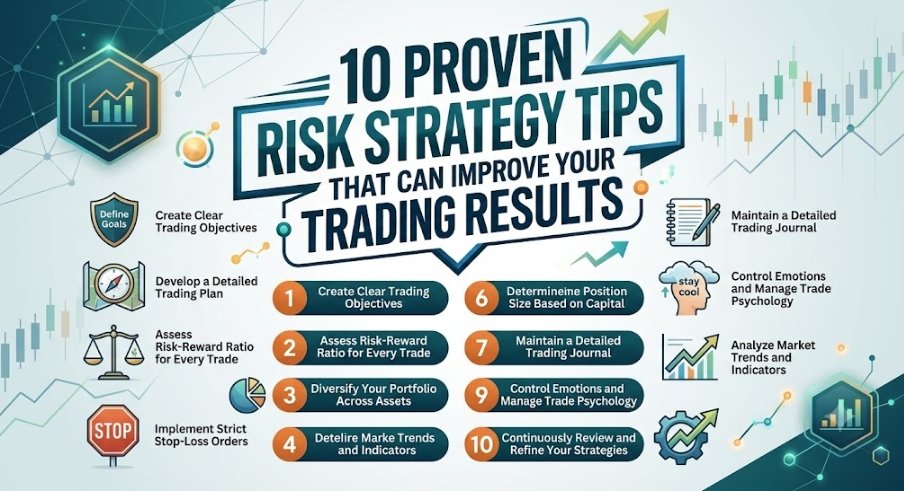
Trading is often painted as a path to instant wealth, but seasoned professionals know that long-term success is built upon discipline, consistency, and sound methodology. Without a proper plan, even the most talented individuals can fall victim to impulsive decisions, emotional volatility, and catastrophic financial losses in volatile markets.
To succeed, you must move beyond gambling and embrace a professional mindset. Developing a comprehensive Risk Strategy is the cornerstone of sustainable growth. By prioritizing capital preservation over aggressive gains, you create a robust safety net that allows you to weather inevitable market downturns.
Many beginners overlook the importance of risk management, focusing entirely on entry points and technical indicators. While analysis is vital, controlling how much you lose per trade is what ultimately dictates your survival. Mastering these fundamental techniques will transform your trading journey from a speculative gamble into a calculated business.
In this guide, we explore ten proven strategies designed to enhance your trading performance. These principles are not merely suggestions; they are essential survival tools used by the world’s most successful hedge fund managers and retail traders alike. Implementing these tactics will help you achieve the consistency you seek.
1. Always Use Stop-Loss Orders
The most fundamental rule of trading is to protect your capital at all costs. A stop-loss order is your automatic insurance policy, ensuring that a single bad trade does not wipe out your entire account balance. By pre-determining the exact point where you will exit a losing trade, you remove the emotional burden of having to decide in the heat of the moment.
Traders who fail to use stop-losses often find themselves “hoping” for a reversal, which frequently leads to even greater losses. Instead of guessing, set your risk level before you even open a position. Whether you are scalping, swing trading, or holding long-term, having a clear exit point is non-negotiable. Remember, the market has no obligation to reward your patience if you are fundamentally wrong about the trend. Protect your downside, and the upside will take care of itself over time.
2. Implement Proper Position Sizing
Position sizing is arguably more important than your entry strategy. You should never risk more than a small, fixed percentage of your total account equity on any single trade, typically between 1% and 2%. This approach ensures that a string of losses will not significantly damage your portfolio or your psychological state. When you calculate your position size based on the distance to your stop-loss, you are mathematically controlling your exposure. Many amateurs risk too much on a “sure thing,” only to be humbled by market volatility.
By normalizing your risk per trade, you make your results predictable and scalable. If you keep your risk small, you stay in the game long enough to let the law of large numbers work in your favor. Professional traders treat every trade as a business expense, carefully managing the cost of each transaction to ensure long-term profitability.
3. Diversify Your Assets and Markets
Putting all your eggs in one basket is a recipe for disaster in the trading world. If your entire portfolio is tied to a single asset class, such as tech stocks or a specific currency pair, you are vulnerable to sector-specific shocks. Diversification reduces the impact of a single market failure on your overall capital. By trading non-correlated assets, such as commodities alongside indices or currencies, you create a more balanced and resilient portfolio.
When one market is stagnant, another might be trending, providing you with opportunities that would otherwise be missed. However, do not over-diversify to the point where you cannot manage your positions effectively. Find a balance that allows you to spread risk without losing track of your technical setups. A well-diversified approach protects your capital from idiosyncratic risks while keeping you exposed to various profitable market movements throughout the year.
4. Maintain a Detailed Trading Journal
A trading journal is the ultimate tool for self-improvement and accountability. It is not enough to simply trade; you must track your rationale, emotions, and the outcome of every single position you take. By reviewing your journal regularly, you can identify recurring patterns, such as overtrading, emotional exits, or failure to follow your own rules. Every mistake written down is a lesson learned, rather than a financial loss forgotten.
Over time, your journal becomes a roadmap of your growth, showing you exactly what works and what does not. Review your journal weekly to fine-tune your strategy based on objective data rather than vague impressions. The best traders are those who constantly analyze their behavior and make incremental adjustments. If you are serious about becoming a profitable trader, you must treat your journal as the most important document in your professional library.
5. Control Your Emotional State
Emotions are the greatest enemy of the disciplined trader. Fear, greed, and frustration often cloud judgment, leading to impulsive trades that ignore established risk protocols. When you feel a strong emotional pull to enter or exit a trade, it is usually a sign that your position size is too large or your plan is nonexistent. To combat this, you must develop a routine that keeps your head clear. Take breaks between trades, meditate, or engage in physical exercise to manage stress levels.
If a loss leaves you feeling angry or desperate to “get it back,” step away from the terminal immediately. Revenge trading is the fastest way to blow up an account. By cultivating a detached, analytical mindset, you ensure that your trading decisions remain based on logic and evidence, not on transient moods or market panic.
6. Avoid Over-Leveraging Your Positions
Leverage is a double-edged sword that can amplify both gains and losses significantly. While it allows smaller accounts to trade larger positions, it also increases the speed at which capital can be liquidated during market swings. Many traders fall into the trap of using maximum leverage, believing it is the fastest route to wealth. In reality, it is the fastest route to zero. Use leverage sparingly and only when you have a high-conviction setup.
Always consider the potential for a “black swan” event or a sudden market gap that could trigger a margin call. If you find yourself constantly worrying about your account balance, you are likely over-leveraged. Reduce your position sizes until the risk feels manageable and comfortable. Sustained profitability comes from preserving capital, not from chasing maximum leverage that puts your entire trading account at risk in a single, volatile afternoon.
7. Stick to Your Trading Plan
A trading plan is your blueprint for success, outlining your entry criteria, exit strategy, and risk tolerance. The problem for most traders is not creating the plan, but sticking to it when the market becomes unpredictable. Straying from your plan during volatile periods is a sign of weakness that almost always leads to losses. If your analysis says to wait for a breakout, do not enter early just because you are bored.
If your exit signal triggers, close the position regardless of your hopes for a reversal. Consistency is the hallmark of professional trading. If you find that you cannot follow your plan, it may be time to revise it to better suit your personality. However, do not change it in the middle of a losing streak just to avoid pain. Only change your strategy after rigorous backtesting and objective review of your results.
8. Focus on Risk-to-Reward Ratio
The risk-to-reward ratio is the foundation of long-term profitability. You do not need to win 90% of your trades to be a wealthy trader; you only need your winners to be larger than your losers. A common goal is to aim for at least a 1:2 or 1:3 risk-to-reward ratio on every setup. This means for every dollar you risk, you are aiming to make two or three dollars in profit. By maintaining this ratio, you can actually lose more than half your trades and still remain profitable overall.
Many beginners focus too much on hit rate, which can lead to holding losers too long. Shift your focus toward identifying high-probability trades where the potential reward significantly outweighs the risk. This simple shift in perspective takes the pressure off having to be “right” on every single trade, allowing you to trade with patience and confidence.
9. Understand Market Correlation
Assets often move in tandem based on macroeconomic factors, and ignoring these correlations can lead to unintentional, double-sized exposure. For instance, if you are long on multiple stocks in the same sector while also long on the index itself, you are essentially betting the same outcome multiple times over. If that sector crashes, your entire portfolio suffers simultaneously. To optimize your risk strategy, understand how the assets you trade relate to one another.
Use correlation matrices to ensure that your positions are truly diversified and not just different tickers hiding the same underlying risk. By avoiding heavy overlap in your portfolio, you protect yourself against concentrated market moves. A deeper understanding of these relationships will allow you to construct a portfolio that is more resilient to market shifts and better positioned to capitalize on diverse opportunities across various global financial markets.
10. Stay Informed, Not Overwhelmed
Information is vital, but information overload can be paralyzed. There is a fine line between staying informed about market conditions and drowning in useless noise. Focus on the data that directly impacts your specific assets, such as interest rate decisions, earnings reports, or key technical levels. Avoid spending your entire day watching financial news networks that prioritize sensationalism over actionable insights.
Too much data can lead to analysis paralysis, where you become so overwhelmed by conflicting opinions that you fail to take a position when the setup is clearly there. Filter your sources, prioritize quality over quantity, and keep your workspace focused. By maintaining a clean, data-driven approach to information gathering, you stay sharp and responsive. Remember that successful trading is about executing your strategy with clarity, not knowing every single headline that crosses the wire throughout the day.
Frequently Asked Questions
What is the best way to determine stop-loss placement?
Base your stop-loss on market structure, such as support and resistance levels, rather than an arbitrary dollar amount.
How much should I risk per trade?
Most experts recommend risking between 1% and 2% of your total account equity on any single position.
Is a trading journal really necessary?
Yes, it is the only objective way to track your performance, identify emotional biases, and refine your overall trading strategy.
Can I trade without using any leverage?
Absolutely. Trading without leverage reduces your risk significantly, making it ideal for beginners who are still learning the ropes.
How do I stop revenge trading?
The best way is to set a daily loss limit. If you reach it, stop trading for the rest of the day.
Conclusion
Improving your trading results is not about finding a secret indicator or predicting the future. It is about implementing a rigorous, disciplined approach to managing your risk. By following these ten tips from using stop-losses to maintaining a journal you shift the odds in your favor. Treat your trading like a professional business, remain patient, and prioritize capital preservation above all else. Success in the markets is a marathon, not a sprint. Keep learning, stay disciplined, and your results will inevitably improve over time.